
Explosive Repeats: The Smart Conditioning Method for Power, Endurance, and Faster Recovery
Spotify | Apple | YouTube
If you think effective conditioning means you need to be dry-heaving into a gym trash can or needing a tow truck to make it to your car afterward, I have some great news for you: you've been lied to.
Somewhere along the way, a lot of us bought into this idea that if we're not completely wrecked, gasping for air, and questioning our life choices by the end of a conditioning workout, then it wasn't "hard enough."
But guess what? Your body doesn't actually care how miserable you feel. It cares about the stimulus you're giving it.
And there are smarter, more strategic ways to improve your conditioning than just going as hard as humanly possible and hoping for the best.
Enter: the Explosive Repeat Method.
This is a conditioning technique that focuses on improving your ability to repeatedly perform explosive movements without turning you into a puddle of regret on the gym floor. It's especially great for athletes or anyone who wants to maintain power throughout a game, match, or just... life. Because being able to sprint after your kid (or dog) without needing a 20-minute recovery is bragging rights worthy.
In this article, I'm breaking down exactly what explosive repeats are, how to do them, and why they might be the missing piece in your conditioning puzzle.
And if you want even more on this topic, my co-host Jaime and I dove into this (along with tempo intervals, sled work, and a bunch of other good stuff) in the Deadlifts and Pizza episode above.
We also talked about things like how caffeine affects fat loss, why your progress slows down as you get more experienced, and we even ranked a bunch of exercises from S-tier to F-tier because apparently we love ranking things.
But for now, let's focus on explosive repeats and how they can help you build better conditioning without the burnout.
What is the Explosive Repeat Method
I know, the name sounds like something a professional athlete does in a Gatorade commercial while someone screams at them to "Dig Deeper!" But in reality, it’s a little more intentional than that.
At its core, the Explosive Repeat Method is a conditioning technique designed to help you do explosive things over and over again without the quality of your movement falling off a cliff.
The "Why" Behind the "What"
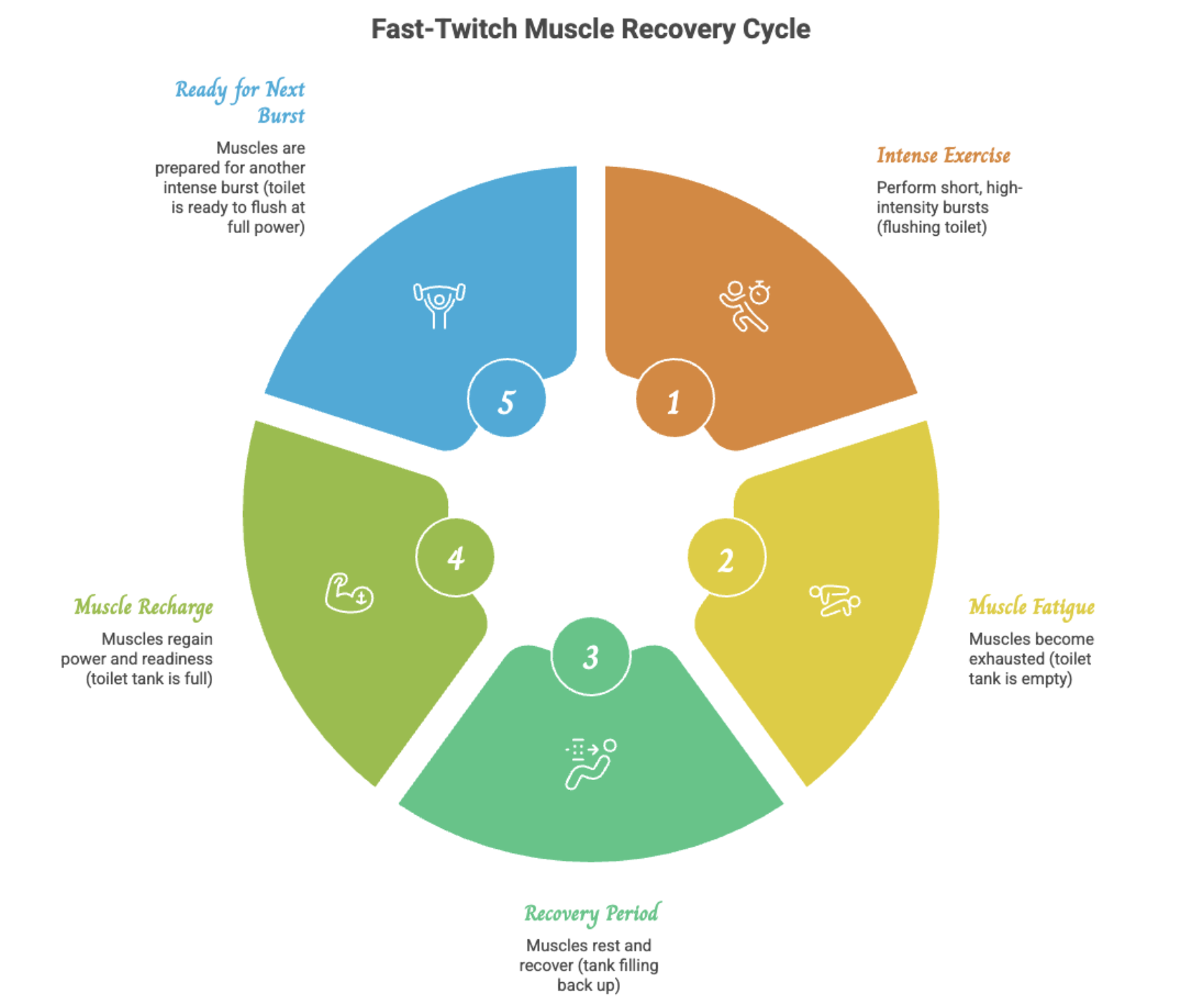
To understand why this works, we have to talk about your fast-twitch muscle fibers. These are the fibers responsible for power, speed, and strength. They’re the ones you use when you need to sprint, jump, or react quickly.
The problem is that fast-twitch fibers are notoriously "lazy" when it comes to recovery. They produce a massive amount of power, but once they’re spent, they usually want to take a nap.
Think of it like flushing a toilet. You flush it, and it does its job with 100% power. But if you try to flush it again five seconds later, you just get a sad, weak little swirl of water. You have to wait for the tank to refill completely before you can get that same "explosive" result.
Most conditioning methods just tell you to keep pulling the handle even when the tank is empty. You’re "working hard," but you aren’t actually being explosive anymore, and not swirling to your full potential.
By performing short, intense bursts of exercise (8–15 seconds) followed by a short period of active recovery, we are literally training your body to "refill the tank" faster.
The Science (Simplified)
I’m not going to bore you with a textbook definition, but this method essentially builds up the mitochondria (the little energy factories) inside those fast-twitch fibers.
More mitochondria in your fast-twitch fibers means:
You can maintain your peak power throughout a long workout or a game.
You recover faster between sets.
You don’t feel like a shell of a human being after doing something fast or heavy.
This is the difference between an athlete starting off like a highlight reel for the first five minutes and then completely falling apart, versus being the person who can sustain that "top of your game" performance from the first whistle to the very last.
How to Perform Explosive Repeats
Alright, now that you know what explosive repeats are and why they work, let's talk about how to actually do them without screwing it up.
The setup is pretty straightforward, but the details matter.
Pick Your Exercise
First, you need to choose an explosive movement. We're talking squat jumps, jump lunges, med ball slams, plyo push-ups, box jumps - basically anything that requires you to produce a lot of force quickly. If it feels like you're launching yourself (or something else) into the atmosphere, you're on the right track.
The landmine is a great too for this also.

The Work-to-Rest Ratio
Here's the formula: 8 to 15 seconds of explosive work, followed by 30 to 60 seconds of active recovery.
When you're just starting out, lean toward the lower end of the work time (8 seconds) and the higher end of the rest time (60 seconds). As you get more conditioned and your "toilet tank" refills faster, you can gradually increase the work time and decrease the rest.
For the active recovery portion, you're not sitting down and scrolling Instagram. You're walking, on an exercise bike, light jogging, or doing something low-intensity to keep your heart rate from tanking completely.
Personally? I like to dribble a tennis ball. I know, I probably look like a middle-aged woman who’s lost her mind (or her dog), but it works. It keeps me moving, it works on my coordination, and most importantly, it’s not boring. It keeps me in that "active" zone without me having to think about how much I hate the treadmill. If you have a hobby that involves moving at a moderate pace, this is the time to do it.
Sets and Series
You'll do 6 to 10 sets per exercise. That's one "series." You can do 1 to 3 series per workout, depending on how much conditioning you want to add and how much time you have.
Between each series, take a longer break—5 to 10 minutes of active recovery (more light jogging, more biking, more dribbling, whatever).
Frequency
Don't feel the need to do this every day. Hit it once or twice a week and call it good. That’s the sweet spot for seeing progress while still having enough gas in the tank for the rest of your life.
The Golden Rule: Max Effort, Not Max Exhaustion
Here's the part people mess up: every single rep should be performed at maximum effort. You're not trying to go to exhaustion. You're trying to stay explosive.
If you start to feel yourself slowing down (your jumps are getting lower, your slams are getting weaker, or you're just not moving with the same snap) stop. Either lower your work time or increase your rest. The goal is to keep producing a lot of force on every rep. If you can't do that, you're no longer doing explosive repeats. You're just doing tired repeats, and that defeats the entire purpose.
Think quality over quantity. Always.
Why Explosive Repeats Are Awesome
If the fact that you don’t have to dry-heave into a trash can isn’t enough to sell you on this method, let’s talk about why this is such a game-changer for your actual fitness.
You'll Improve Your Power Endurance
This is the big one. Power endurance is your ability to stay explosive over time. It's what separates the athlete who sprints hard in the first quarter and then spends the rest of the game looking like they're running through wet cement, versus the one who's still flying around in the final minutes.
Most training either builds your strength (how much force you can produce once) or your endurance (how long you can keep going at a moderate pace). But power endurance? That's the ability to produce a lot of force, recover quickly, and do it again. And again. And most people never train this quality specifically.
Explosive repeats train your fast-twitch muscle fibers to regenerate faster. You're literally teaching your body to "refill the tank" quicker so you can stay powerful throughout an entire workout, game, or match.
It's Not as Stressful as HIIT
The good news is you can improve your conditioning without destroying yourself in the process.
Traditional HIIT workouts have their place, but they're incredibly taxing on your central nervous system. You're going all-out, to complete exhaustion, over and over. That beats you up. And if you're also trying to get stronger, build muscle, or just live your life without feeling like you got hit by a truck, that level of stress can be a problem.
Explosive repeats give you a conditioning stimulus without the same level of systemic fatigue. You're working hard during those 8 to 15 seconds, but you're not grinding yourself into dust. You're training smart, not just hard.
You'll Boost Your Mitochondrial Density
Remember those little energy factories we talked about earlier? Explosive repeats effectively increase the number of mitochondria in your fast-twitch muscle fibers. More mitochondria means better energy production and faster recovery between efforts.
This is usually something that only happens with long, slow cardio in your slow-twitch fibers, but explosive repeats do it for your fast-twitch fibers. You’re basically turning your "sprint" fibers into "marathon-capable" sprint fibers.
It's Functional Fitness That Actually Matters
Look, I'm all for getting stronger and building muscle. But at the end of the day, fitness should make your life better, not just make you look good in a tank top.
It’s being able to lunge forward to catch a falling child, sprint after a dog that spotted a squirrel, or catch your balance after a trip. Life is explosive. If you only ever train slow and steady, you’re going to be a bit "laggy" when you actually need to move fast. This training ensures you have that "snap" when it matters most.
It Trains a Different Energy System
Most people train either their aerobic system (long, steady cardio) or they do circuit training where they're too tired to actually produce much force. Explosive repeats hit that middle ground: the alactic-aerobic system, which bridges the gap between pure power (alactic) and pure endurance (aerobic).
It's a different stimulus than what most people are doing, which means it can unlock progress even if your conditioning has felt stuck for a while.
Explosive Repeat Workout
If you’re ready to stop being "laggy" and start building that power endurance, here’s a 4-week sample progression.
Remember: for the Active Rest, find your version of my tennis ball dribbling. Lightly jog, go at a slow pace on a piece of cardio equipment, or just pace around the gym like you’re waiting for a very important phone call.
The Routine
Perform all sets for Series 1, take your long break, then move to Series 2, and so on.
Series 1: Alternating Jumping Lunges
Series 2: Med Ball Rotational Slams
Series 3: Lateral Skater Jumps
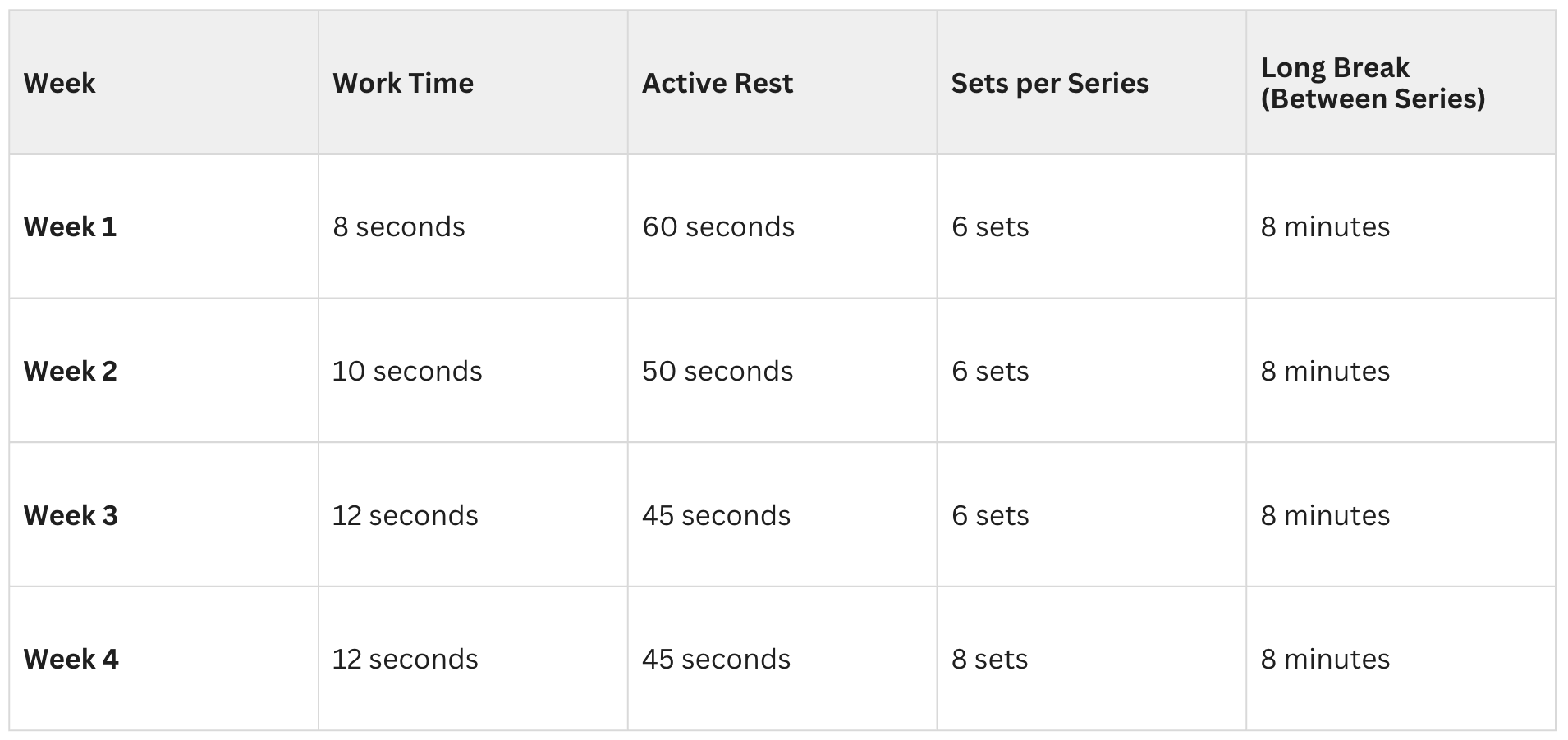
This is just to show you how you can progress. If you are not ready to go up a level, stay where you’re at, and only move when you’re ready. Remember your sets should be all out power.
How to Keep Progressing
Once you’ve finished this 4-week block, you don’t have to go back to boring cardio. You can keep the progress coming by:
Squeezing the Interval: Gradually increase your work time (up to 15 seconds) and decrease your rest (down to 30 seconds).
Adding Volume: Add a few more sets to each series (up to 10)
Increasing Intensity: As long as you can stay explosive, you can use a slightly heavier med ball or jump a little higher/further.
Improving Explosiveness: This is not always measurable, but a very valid way to progress. If your jumps are higher, your slams are faster, or you’re performing your exercises with more power, than you are progressing.
A quick reality check: If you find that your "explosive" jumps in Week 4 look more like you’re trying to hop over a puddle in dress shoes, you’ve pushed too far. Go back down a level. The goal is to stay snappy, not to see how much you can suffer.
Common Mistakes
Treating it Like A Bootcamp Class: If you are gasping for air and your form is falling apart, you aren't training your power anymore, and the workout will stop being effective. Refer back to the toilet analogy.
Going Half-Speed: You have to give maximal effort during those 8–15 seconds. If you’re just "going through the motions," your fast-twitch fibers are going to stay on their metaphorical couch and no changes will happen.
Short-changing the Long Rest: Those 5–10 minutes between series might feel like forever, but your nervous system needs that time to reset so you can be explosive again for the next round.
Final Thoughts
If you’re an athlete, someone who likes to train like one, or just a normal person who is bored to tears with their current conditioning routine, explosive repeats could be the upgrade you’ve been looking for.
You don’t have to choose between the dull monotony of a treadmill or the kind of bootcamp class that makes you wonder why you paid someone to make you this miserable. There is a middle ground where you can actually improve your athletic performance, boost your energy factories, and feel like a high-performance human being without the burnout.
Add this to your routine once or twice a week when your conditioning starts to feel stale. You’ll probably be surprised at how much better you feel, and how much more "snap" you have in your everyday life, when you stop training to be tired and start training to be powerful.
Now, go out there, find a tennis ball to dribble, and start refilling that tank.

Want to learn more about training for power?
My Power Training Template shows you how to program power into your workouts using smart, athletic movements. It includes a simple framework, tons of exercise options, and a sample workout so you can plug things in and train with purpose.
Frequently Asked Questions
-
Explosive Repeats could technically be considered a form of HIIT, but the intention is different. HIIT is about training near your max heart rate, where explosive repeats are about training with max explosiveness.
HIIT usually means pushing to exhaustion with short rest and explosive repeats are about max output with enough rest to stay powerful.
-
Yes, it can absolutely support fat loss, but it’s not its main intention.
Explosive repeats jack up energy demand, recruit a ton of muscle, and improve how efficiently your body uses fuel. All of that helps. But fat loss still comes down to the big rocks: nutrition, total activity, sleep, and consistency.
-
Nope.
You need to be able to perform the movement safely and with intent. That’s it. Explosive doesn’t mean reckless. A lower jump done aggressively with good mechanics beats a sky-high jump that looks like a baby deer on ice.
If you need to, start with low impact exercises.
Start where you are. Progress gradually.
-
Absolutely.
Med ball slams, battle rope power waves, explosive kettlebell swings, sled pushes, bike sprints, rower sprints, or even fast, powerful step-ups can all work.
Explosive is about intent and speed, not airtime.
-
You’ll notice a few things pretty quickly:
You recover faster between hard efforts
You’ll be able to stay explosive longer
You don’t feel as wrecked after conditioning sessions
Everyday stuff feels easier
If you’re finishing workouts feeling energized instead of annihilated, then you’re moving in the right direction.
-
Yes. And arguably, it’s more important.
Power is one of the first things we lose with age, and one of the hardest things to get back if we ignore it. Explosive repeats, done intelligently, help preserve that ability without beating your body into the ground.
Train smart. Pick appropriate movements. Respect recovery. You’re building capacity, not trying to annihilate yourself.



Diet breaks let you eat more and still lose the same amount of fat, if you structure them right. Plus: why you don't need to go to all the way to failure to build muscle or get stronger.