
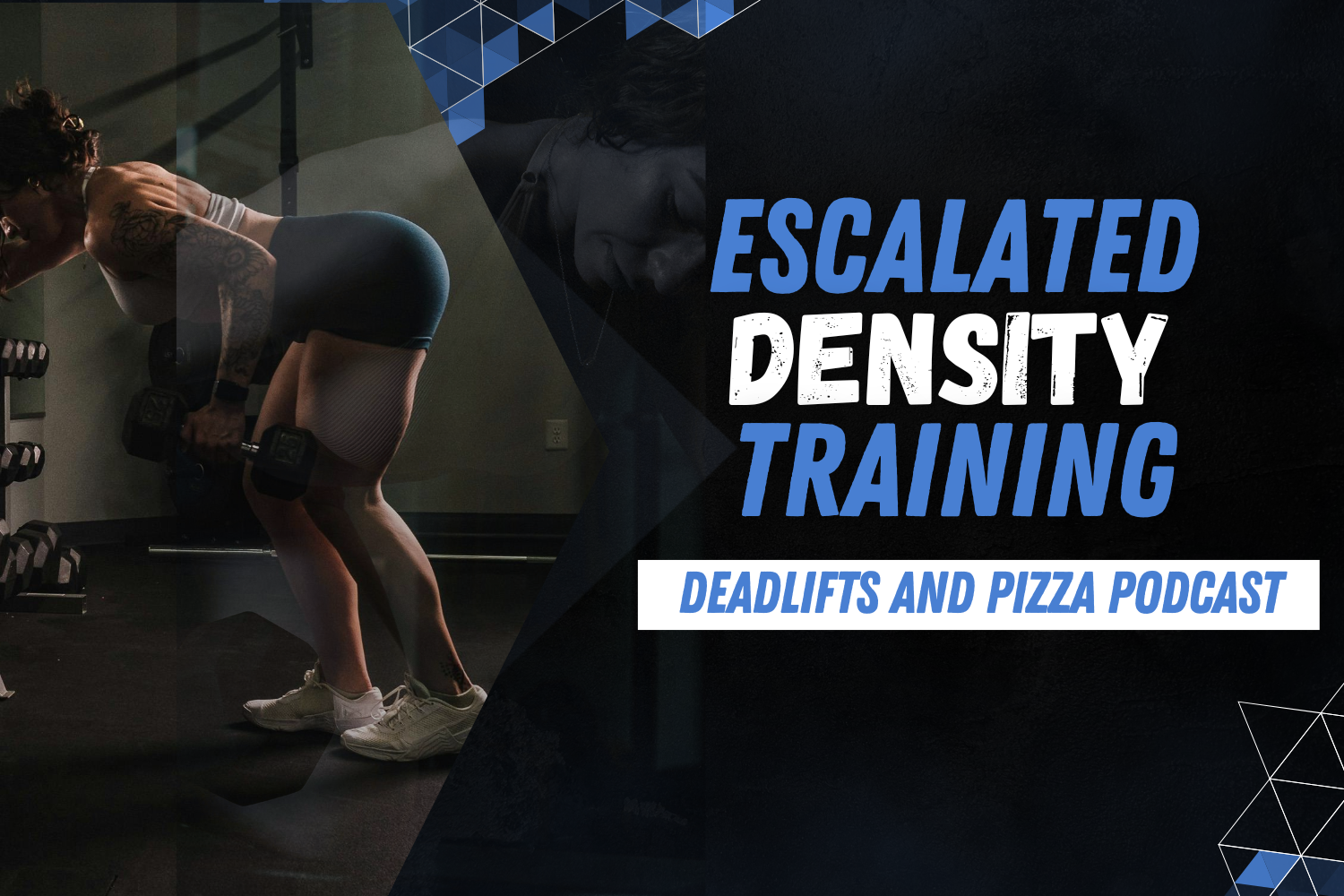
Escalated Density Training (EDT): How to Build Muscle More Efficiently With Shorter Workouts
Spotify | Apple | YouTube
If there’s one thing almost everyone wants from their training, it’s better results without spending more time in the gym. But is that even possible? Are there strategies you can actually use to make that happen?
The answer is yes! And today we’re going to talk about one of them: Escalated Density Training (EDT).
EDT is a training method that focuses on doing more quality work in the same amount of time. You set a timer and see how much work you can get done inside that window. Over time, the goal is to progressively increase your workload and beat your previous “score.”
This is something we touched on in our latest Deadlifts and Pizza podcast episode. In that episode, we covered a bunch of topics including a study on how sweets affect cravings, another on whether spot reduction is actually a thing, and we answered some listener questions. One topic I wanted to spend more time unpacking here, though, is Escalated Density Training.
EDT is one of those concepts that can sound a little “advanced” at first, but once you understand it, it’s actually very practical. Especially if your goal is to build muscle efficiently without your workouts getting longer and longer.
So in this article, I want to break down:
What EDT actually is
Why it might be beneficial to add to your training
And how to use it correctly to get more work done in less time
If you’ve ever felt like your workouts are getting longer but not necessarily more productive, this is for you.
What is Escalated Density Training (EDT)
Escalated density training is actually pretty simple. Just remember that simple doesn’t mean easy. Trust me.
In training, density refers to the amount of work (sets, reps, volume) completed within a specific, set amount of time. EDT is designed to do more work in the same amount of time each session, with the goal of building muscle and increasing strength and work capacity. It basically has progressive overload built into it, because you’re trying to increase your total volume each time you repeat the workout.
Think of EDT like a workday with a hard stop. You don’t get to stay late, and you don’t magically add more hours to the day. But over time, you get better at focusing, transitioning between tasks, and using your time more efficiently.
As a result, you’re able to get more done within the same number of hours. You didn’t work longer, but you increased how much you could accomplish in the time you already had. That’s the difference between just doing more work and increasing work density. Who doesn’t love being efficient?
Why EDT is Good For Building Muscle
One of the biggest drivers of hypertrophy (building muscle) is quality volume. EDT shines here because it naturally pushes you to accumulate more volume without having to spend hours in the gym.
When you train with EDT, you’re repeating the same movements in the same time frame and gradually getting better at producing work. That means more reps, more sets, and more total tension on the muscle across weeks. All good things for muscle hypertrophy.
It also allows you to work hard without needing to take every set to failure. You’re doing enough work to challenge the muscle, but not so much that recovery becomes an issue. That balance matters if you want to keep training consistently.
Another benefit is that progress doesn’t rely entirely on adding weight to the bar. You can use the same load and still make progress by completing more work with it. That is a nice change of pace if you’re anything like me.
Over time, those small increases add up. More total work done across weeks means more stimulus for muscle growth, without workouts getting longer and longer.
How to Actually Set Up a EDT Block
Now that you know why you might want to add this to your programming, let’s talk about how to add it.
First, pick a short, fixed amount of time. Traditionally that’s 15 minutes, but you can adjust it based on your training schedule and experience level. A good rule of thumb is 8–15 minutes. The goal is to get as much quality work done in that allotted time. When the timer ends, you stop.
Next, choose two exercises that don’t interfere with each other’s recovery. Usually that means opposing muscle groups (push/pull) or pairing an upper-body movement with a lower-body movement.
Then, choose your weight and reps. A common approach is to use your 10-rep max and perform sets of 5 reps with that weight. You can adjust this depending on your goals. If you’re more strength-focused, you might choose a heavier load (for example, a 6-rep max and perform sets of 3). If you care more about muscular endurance, you could go lighter (12–15 rep max and perform sets of 8).
As the rounds go on and fatigue builds, the reps you can perform per set will likely decrease. That’s normal. You might start with 5 reps per set, drop to 4, and toward the end maybe only manage 1–2 reps. That’s part of the process.
You’ll rest intuitively. There are no prescribed rest periods. Take short breaks as needed, but avoid turning it into a full two-minute intermission between every set. The idea is to keep moving while still maintaining quality reps.
The next time you repeat this workout, everything stays the same — same time frame, same exercises, same weight — but you’ll try to beat your total reps completed. That might mean holding your starting reps longer before they drop off, or taking slightly shorter breaks and completing more total sets.
Once you can increase your total reps by about 20%, you can raise the weight and start the process over. Also, if you’re able to maintain your starting reps the entire time with minimal rest and a high number of sets, that’s usually a sign the weight was too light to begin with. Adjust accordingly next session.
Sample Workouts
To make this more concrete, here are two simple examples of how you could structure an EDT block.
Directions: Perform each exercise back to back and continue alternating for the entire time block. Keep track of your total reps for both movements.
Your goal next session? Beat that number.
Option 1: Opposing Muscle Groups (Push/Pull)
Time: 15 mins
Exercises: Bench Press + Chest-Supported Dumbbell Row
Reps:
Strength focused: Start with 3 reps per exercise using your 6RM weight
Balanced: Start with 5 reps per exercise using your 10RM weight
Muscular Endurance: Start with 8-10 reps per exercise using your 12-15RM weight.
You can use warm-up sets to estimate your max. As fatigue builds, your reps per set will likely decrease. That’s normal.
Rest: Minimal, as needed
Sets: As many as you can in the allotted time
This setup works well because while you’re pressing, your back is recovering. While you’re rowing, your chest and triceps are recovering. That allows you to go back and forth between exercises with minimal breaks.
Option 2: Upper Lower Pairing
Time: 15 minutes
Exercises: Barbell Romanian Deadlift + Dumbbell Shoulder Press
Reps:
Strength focused: Start with 3 reps per exercise using your 6RM weight
Balanced: Start with 5 reps per exercise using your 10RM weight
Muscular Endurance: Start with 8-10 reps per exercise using your 12-15RM weight.
Again, use warm-up sets to estimate your max. Reps will likely drop as fatigue builds.
Rest: Minimal, as needed
Sets: As many as you can in the allotted time
This pairing works because the lower body movement doesn’t interfere much with the upper body movement. Your shoulders get a break while your hamstrings work, and vice versa.
You don’t need fancy combinations. Simple, compound movements tend to work best. And remember, the goal isn’t to destroy yourself in 15 minutes. It’s to accumulate quality work and then repeat that process next time slightly better than before.
Common Mistakes With EDT
Like anything else in training, EDT works really well when you apply it correctly, but not so well when you turn it into something it’s not.
Here are a few common mistakes to avoid:
1. Turning It Into Cardio
Your breathing will probably pick up. That’s normal. But EDT is still strength training.
If you’re flying through sloppy reps, rushing transitions, or treating it like a conditioning circuit, you’re missing the point. The goal is quality work, not just nonstop movement.
If your form falls apart halfway through the time block, you need to do less reps or rest a little longer.
2. Going Too Heavy
This one is common.
People can underestimate how difficult EDT can be. “Performing only 5 reps with my 10 rep max… Pfft. That’s easy.”
That’s what they think until they get to round 5 and realize they’ve made a grand mistake.
If you pick a weight that’s so heavy you’re forced into long rest periods after every set, you’ve defeated the purpose. Remember, density means doing more work in the same amount of time.
If you’re resting two to three minutes between every set, you’re just doing normal strength training with a timer running.
3. Starting Too Light
On the flip side, if you can maintain your starting reps the entire time without much effort, you probably undershot the weight.
EDT should feel challenging. Not impossible. But challenging.
There’s a sweet spot where reps gradually drop as fatigue builds. That’s usually where you want to be.
4. Changing Variables Too Often
If you change the exercises, weight, and time block every session, it becomes very hard to track progress.
Part of what makes EDT effective is that it’s measurable. Keep the structure the same long enough to actually see improvement. Then adjust.
EDT is simple, but it rewards patience and consistency. If you respect the structure and focus on quality reps, it can be a very efficient way to build muscle and improve work capacity without living in the gym.
How to Incorporate Escalated Density Training Into Your Programming
Escalated density training can be taxing. This isn’t something I would add to every program, or use for every exercise in your program. I would use it sparingly. Something like 2–3 EDT blocks within a training cycle is usually plenty.
I prefer to add it at the end of a workout as a finisher. That way I know I can give it my full effort and not worry about having to get through a bunch of heavy compound lifts afterward when I’m already spent. I don’t have to pace myself. I can just focus on the work.
That said, you can structure an entire session around EDT if you want to. Some people like to run two separate time blocks in one workout (for example, two upper-body and one lower-body pairings. Push/Hinge & Pull/Squat ). That works too. Just be mindful of overall fatigue.
The biggest thing to remember is EDT is a tool. It’s not mandatory. Use it where it makes sense. Rotate it in for a phase when you want to emphasize volume, efficiency, or work capacity. Then rotate it out.
You don’t need to marry it. Just use it well.
Final Thoughts
Escalated density training is a great way to add more volume to your workouts and push yourself in a way you may not be used to.
If your workouts are starting to feel stale, or you want to test yourself without adding more time in the gym, give it a shot.
It’s simple. It’s efficient. And it’s more challenging than it looks on paper

Want a proven program to get started?
If you like structured training with clear progression (and no fluff), I put together a Free 6-week hypertrophy & strength program you can grab below.
Frequently Asked Questions (FAQ)
-
Yes. EDT is great for building muscle because it helps you accumulate more high-quality volume in a set amount of time. Over weeks, you progressively do more total reps and sets, which creates a strong hypertrophy stimulus without your workouts getting longer.
-
EDT is usually better for hypertrophy and work capacity, but you can still make strength gains depending on how you set it up. If you use heavier weights (like a 6RM and sets of 3), it can support strength. If you use moderate weights (like a 10RM and sets of 5), it’s more hypertrophy focused.
-
You don’t need to use it year-round. It works well in phases where you want to emphasize volume and efficiency. For most people, 4–6 weeks is a solid block before rotating to something else.
-
Technically, yes. But it’s probably unnecessary.
If you’re a beginner, you don’t need a high amount of volume to see progress. Almost anything done consistently will work for you in the beginning. I would focus more on getting stronger, building good technique, and becoming comfortable with your main lifts before adding something like EDT.
It’s not that beginners can’t do it. It’s just that they don’t need it yet.
-
As long as you need to maintain good reps, but not so long that you turn it into traditional straight sets with full recovery between each one. Think controlled, not rushed.
-
No. EDT works best when you stay 1–3 reps shy of failure most of the time. The goal is consistent, repeatable quality work. If you go to failure constantly, you’ll gas out too early and your total volume will suffer.
-
A common rule is to increase weight once you improve your total reps by about 15–20%. For example, if you hit 100 total reps across both lifts, once you can hit around 115–120 reps, it’s probably time to bump the load up.
-
Avoid exercises that are overly technical or fatigue your lower back too quickly, especially if you’re new to EDT. Heavy barbell deadlifts, max-effort Olympic lifts, or anything that breaks down under fatigue is usually a bad idea.


Diet breaks let you eat more and still lose the same amount of fat, if you structure them right. Plus: why you don't need to go to all the way to failure to build muscle or get stronger.